
Lindale Mill
Manufacturing and the South.

In Webster and the town of Slatersville
Samuel Slater, builder of Slater’s Mill,
Owned the white hands of men, but not a slave;
Better that Negroes, the well-fed heroic wave
(Its echoes crashing in Atlanta still),
Crashed against Lee at the Foot of Marye’s Hill.

-  Allen Tate, Historical Epitaphs, “On the Founder of the Industrial System of the United States”
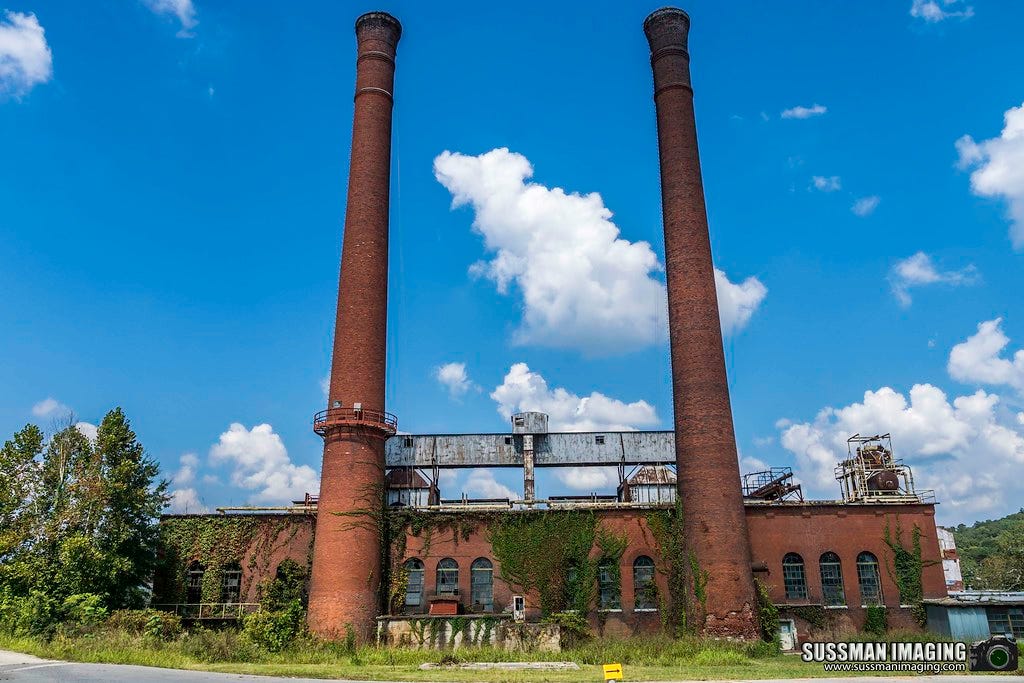
The creek was dotted with a flock of snow-white ducks. A bridge hung above them, bound by tan bricks falling into one another. Falling in an arch. As I passed over it, my eyes surfed the silver face of the water. The buttonbush ran down each side like a frame and a lone magnolia sat in the canvas toward the far bend of the creek. There stood the mill, its red walls half faded and half swallowed up by kudzu vines. The window panes were randomly shattered, as if struck by birdshot, and the breathless smokestacks struggled with the Blue Ridge hills. Industrial thuribles filled with ashes. Down the other bend of the creek sat the town’s old grist mill. It paled in comparison to the cotton mill in both size and age, but it was worn down and barren just the same. Federals had damaged it in 1864 and the basin bricks were falling back into the earth—to be Georgia clay once more.
North of the creek were abandoned and derelict southern-style homes. South of the creek, the same was found. The colors of each home, though different, had all faded. The screened porches were torn and tattered and the balconies on the two story homes had long given up the ghost. Back porches were often boarded up and front lawns donned tires, toilets, and defunct push-mowers. Trampolines were signs of life.
It was a sobering sight. A sight you can’t drink in all at once. There’s too much to it: Sadness, hurt, and broken promises but also life—like peach blossom petals raining down on Shiloh in the spring. It does not lend itself to quick comprehension. It’s been that way for as long as I can remember.
. . .
Every New Year's Eve I make the journey over Silver Creek and past the Lindale Mill. The last Piggly Wiggly in Floyd County sits just by it. Though located across the county from our family’s farm, we trek there for hog jowl, collards, and black-eyed peas each year. It’s a culinary tradition across the South.
The trip is potent every time. Lindale, where the mill and Piggly Willy abide, is a small “unincorporated community” on the outskirts of Rome, Georgia—a slightly larger town in Floyd County. But the citizens of Floyd County know that Lindale is home in the hearts of those who dwell there. It is its own place, set apart from Rome and the other areas surrounding it. People there say they are from Lindale.
Lindale has its own history, too. Before the war it was a farming community in the Blue Ridge hills. Sometime in the 1820s, a Presbyterian Scotsman moved onto a vast swath of farmland probably acquired through a Cherokee land lottery. In the 1830s, he built a small grist mill on the banks of Silver Creek—that same mill now returning to the earth. The mill would grind corn and wheat into cornmeal and flour which he sold to the local residents and the townspeople of Rome. The community was by no means wealthy, but it had everything it needed.
A few years later, the area was granted a rail stop on the tracks running into Rome. But the town needed a name. It settled on Lindale.
Then came Lincoln’s War. The area was hit hard by Federals and, at Grant's behest, Lindale howled with the rest of Georgia (thanks to General Forrest, Rome was spared of destruction).
Then a Massachusetts man came down and built a cotton mill at the tail end of the 19th century. The Mill brought rapid pecuniary prosperity and growth to Lindale that lasted over a century. In the late 20th century, the Pepperell Schools (Lindale’s public schools) were the wealthiest in the county. I recall being shocked when Momma, who went to Armuchee High School on the other side of the county in the 1990s, revealed this to me: They always had the newest things. The newest cars at football games, the newest clothes… the newest everything, really. Their daddies all worked in the mill. Besides the lawyers and bankers, it’s where all the high cotton lived.
It shocked me because it ran contrary to what I had known all my life. The Pepperell Schools were the poorest in the county system by a country mile when I was going through school. I literally grew up hearing Lindale referred to as “Methlehem.” Some of more delicate constitutions were even afraid to go there for football games after dark.
This is because the Lindale Mill closed in 2001, the year I was born. It simply couldn’t compete with the offshoring of manufacturing, so it offshored too. Subsequently, Lindale was swiftly ushered into destitution. The farms were all gone. Everyone in the area relied on the mill, so there was hardly anything to fall back on. In the blink of an eye a thriving community fell into the depths of homelessness, drugs, and poverty.
Pater meus agricola est.
“My father is a farmer.”
- John 15:1
It calls one to ponder the South's historied hesitation with manufacturing. After all, it was the Sage of Monticello who claimed “those who labour in the earth are the chosen people of God, if ever he had a chosen people, whose breasts he has made his peculiar deposit for substantial and genuine virtue. It is the focus in which he keeps alive that sacred fire, which otherwise might escape from the face of the earth. Corruption of morals in the mass of cultivators is a phenomenon of which no age nor nation has furnished an example. It is the mark set on those, who not looking up to heaven, to their own soil and industry, as does the husbandman, for their subsistence, depend for it on casualties and caprice of customers.”
In his Notes on the State of Virginia Jefferson also demanded: “While we have land to labour then, let us never wish to see our citizens occupied at a work-bench, or twirling a distaff.” He wrote to a friend in 1816, “agriculture is productive, manufacturing is sterile, and it is nature that makes this so,” and to John Jay in 1785, “cultivators of the earth are the most valuable citizens. They are the most vigorous, the most independent, the most virtuous, & they are tied to their country & wedded to its liberty & interests by the most lasting bonds.”
This understanding of society was not unique to the South’s philosopher par excellence. It was also shared by one of its chief statesmen. No, not John C. Calhoun; the man who made him: John Randolph of Roanoke.
“I have lived and hope to die a freeholder, and when I lose that distinction I shall no longer have any reason to be proud of being your faithful servant.” With these candid words Randolph addressed his fellow Virginians before the state convention of 1829. He would die a few years later, but they faithfully capture the breath of his life’s work.
It was in the proceedings of that convention where “Mr. Randolph said, he believed he was not singular in the opinion he was about to express… of sincere gratification, on finding that the gentleman who had just taken his seat, was in favor of what he (Mr. Randolph) conceived to be the only safe ground, in this Commonwealth, for the right of suffrage—he meant terra firma: literally firma: The Land. The moment, said he, you quit the land (I mean no pun), that moment you will find yourselves at sea: and without compass—without land-mark or polar star.”
Indeed, it is no exaggeration to say that the whole of Randolph’s career, at its peaks and valleys both, spun around The Land. For Randolph, this landed vision was embodied best by independent, freeholding planters and farmers. The meat of free society was “the good old Virginia planter—the man who lived by hard work, and who paid his debts.”
His cause, Virginia’s cause, and the South’s cause, was nestled in the patient nature of agricultural society. A society with very little to gain from the rapid changes natural to industrial and commercial interests. To Randolph’s mind, society itself was too delicate a thing to gain much from brisk movement and calculating uniformity.
This is abundantly clear all throughout his tenure in Congress, especially in his scruples with Henry Clay. For Randolph, Clay’s American System of industrial and geographical expansion advocated for the application of abstract, simple political concepts to colossal dilemmas. As Russel Kirk says of the two, “Clay stood for the principle of simple uniformity; Randolph for the principle of proliferating variety.”
Inherent in the very name of Clay’s political project—American System—is a problem for John Randolph. After all, in his bones Randolph was a Burkean. Society is not a system; it’s not a machine—a factory—where clean concepts can be imputed and clean results produced. Society is a “moral essence,” a thread of being weaving together the dead, the living, and the unborn. Indiscriminate rules fail to account for natural difference and the organic order of things.
Randolph even fought the political methods at the heart of Clay’s American System when it came to the Missouri Compromise, which he saw as, according to Kirk, “an endeavor to gloss over a terrible problem by the application of a coat of generalities and a superficial reconciliation of interests.”
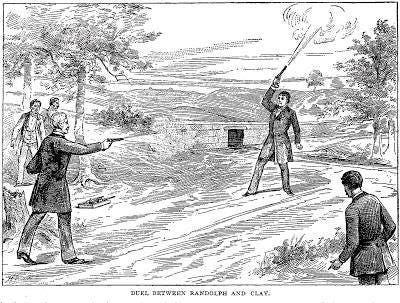
Ultimately, his quarrel with Clay was civilizational. In Randolph and Clay we find two antithetical visions for the republic. Indeed, two antithetical understandings of the political and social world. But their core difference was over industry and agriculture.
One key part of Clay’s American System was the Tariff of 1816, which Randolph saw as “a system of bounties to manufacturers to encourage them to that which, if it be advantageous to do at all, they will do, of course, for their own sakes.”
The Tariff of 1816 was the first congressionally established tariff for the purpose of protecting U.S. manufacturing interests (well within the spirit of Clay’s American System). In fact, many Southerner political leaders originally stood behind the tariff. It was only around 1820, in the aftermath of the 1816 tariff and in the face of increased tariff duties that the South turned its back on protectionism. That is, except for John Randolph and the Old Republicans.
Randolph foresaw what Southern planters later watched pass before them in horror: the high tax on English manufacturing (which the South relied on more than Northern industry) would increase the price of Northern manufactured goods that cash poor Southern freeholders now had to buy, in turn requiring England to halt the importation of Southern cotton as their export of manufactured goods declined.
The farmers and freeholders of the Southern states were therefore put on their heels, with tariffs to maintain “American” (Northern) industry they found themselves requiring more of the cash they already didn’t have amidst the forced decline of their chief cash crop.
Randolph was on the foul protectionist scent from the very beginning, though. As Kirk says, for John Randolph “it was simply a question of whether a planter would consent to be taxed to enable another man to set up a spinning jenny… The agriculturalist bore the brunt of the war [1812] and taxation. The agriculturalist, the great stable element of society, was to be pillaged for the benefit of a class of speculators and note-shavers.”
As Randolph said before the Congress on the question of the 1816 tariff: “The agriculturalist has his property, his lands, his all, his household goods to defend… while the commercial speculators live in opulence, whirling in coaches and indulging in palaces… Even without your aid the agriculturalists are no match for them… the manufacturing interests are collected in masses and ready to associate at a moment's warning for any purpose of general interest to the body… The cultivators, the patient drudges of other orders of society, are now waiting for your resolution; for on you it depends whether they shall be left further unhurt or be, like those in Europe, reduced gradatim, and subjected to another squeeze from the hard grasp of power.”
Randolph would continue opposing the tariff and all political projects adjacent to it—particularly the Second Bank of the United States. Still, he was not entirely alone. Other members of the Southern freeholding and planter class were in step with him. He and Thomas Jefferson shared a great many opinions but grew apart over time, especially as Jefferson tried to navigate the still infant presidency. But Randolph’s primary colleagues in the Old Republican faction were men like Nathaniel Macon and John Taylor of Caroline. Undoubtedly, they believed themselves to be the inheritors of a great tradition of agricultural conservatism, extending at least back to Cato the Elder, who began his work, On Agriculture, with the reflection: “It is true that to obtain money by trade is sometimes more profitable, were it not so hazardous; and likewise money-lending, if it were as honorable. Our ancestors held this view and embodied it in their laws, which required that the thief be mulcted double and the usurer fourfold; how much less desirable a citizen they considered the usurer than the thief, one may judge from this. And when they would praise a worthy man their praise took this form: “good husbandman,” “good farmer,” … It is from the farming class that the bravest men and the sturdiest soldiers come, their calling is most highly respected, their livelihood is most assured and is looked on with the least hostility, and those who are engaged in that pursuit are least inclined to be disaffected.”
This was all on the forefront of John Randolph’s thought while fighting on behalf of the South’s agricultural society. To his mind, federal preference for Northern industry imperiled the South at the profit of an inferior way of life—one that many thinkers before and after him feared would seep into the Southern soil and poison it. For Randolph and his friends, according to Kirk, “only in the country, on his own land and free from debt, did a man experience real liberty.” And throughout their political tenures, they spent all their strength championing that life.
Coming up over the horizon, however, was Randolph’s chief ally. It would be the young representative who originally bought into Clay’s American System, advocating for the national industrial project; a young man Randolph scolded in Congress on multiple occasions; a young man who would later convert to Randolph’s Old Republicanism and vindicate his political vision across the South long after his death and up to the dawn of the War Between the States. That man was John Caldwell Calhoun.
I am the holder of no stock whatsoever… except livestock.
- John Randolph of Roanoke
By the time the Tariff of 1828 (Tariff of Abominations) rolled around, and toward the end of John Randolph’s life, South Carolina’s political titan had well embraced Randolph’s philosophy. Responding to that tariff, John C. Calhoun wrote his South Carolina Exposition and Protest, a vital, and remarkably insightful work published over twenty years before his famous Disquisition.
In the Exposition and Protest, we find Calhoun concerned with the very same things as his progenitors: the survival of the agricultural South and the culture it ripened, and the threats that industry and protectionist economics posed to both.
Calhoun summarized the tariff: “The case, then, fairly stated between us and the manufacturing States is, that the Tariff gives them a protection against foreign competition in our own market, by diminishing, in the same proportion, our capacity to compete with our rivals, in the general market of the world. They who say that they cannot compete with foreigners at their own doors, without an advantage of 45 per cent, expect us to meet them abroad under disadvantage equal to their encouragement.”
He thus found the Southern freeholders to be “the serfs of the system, out of whose labor is raised, not only the money paid into the Treasury, but the funds out of which are drawn the rich rewards of the manufacturer and his associates in interest. Their encouragement is our discouragement. The duty on imports, which is mainly paid out of our labor, gives them the means of selling to us at a higher price; while we cannot, to compensate the loss, dispose of our products at the least advance. It is then, indeed, not a subject of wonder, when understood, that our section of the country, though helped by a kind Providence with a genial sun and prolific soil, from which spring the richest products, should languish in poverty and sink into decay, while the rest of the Union, though less fortunate in natural advantages, are flourishing in unexampled prosperity.”
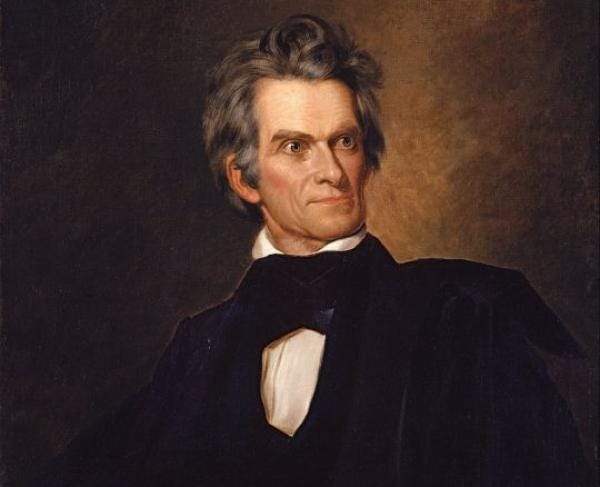
It must be said here that Calhoun is not, as modern protectionists have sloppily claimed, some classical liberal committed to an absolute free trade ideology and opposed to a more common good understanding of economics. Protectionist economic policies were devastating the good common to his people and his country; fundamentally “an agricultural people” as President Jefferson Davis, himself a successful planter, described Southerners in his First Inaugural Address.
“We already see,” Calhoun continued, “indications of the commencement of a commercial warfare, the termination of which no one can conjecture, though our fate may easily be. The last remains of our great and once flourishing agriculture must be annihilated in the conflict. In the first instance, we will be thrown on the home market, which cannot consume a fourth of our products; and instead of supplying the world, as we would with a free trade, we would be compelled to abandon the cultivation of three fourths of what we now raise, and receive for the residue, whatever the manufacturers, who would then have their policy consummated by the entire possession of our market, might choose to give.”
Calhoun’s fears then turned to lamentation: “Forced to abandon our ancient and favorite pursuit, to which our soil, climate, habits, and peculiar labor are adapted, at an immense sacrifice of property, we would be compelled, without capital, experience, or skill, and with a population untried in such pursuits, to attempt to become the rivals instead of the customers of the manufacturing States. The result is not doubtful. If they, by superior capital and skill, should keep down successful competition on our part, we would be doomed to toil at our unprofitable agriculture, selling at the prices which a single and very limited market might give.”
I do not mean here to bark on and on about the tariff. In order to explore the Southern hesitation with manufacturing, though, the tariff is unavoidable. It was the representation of the tension between agriculture and industry in the adolescent republic, and the cause of many of its growing pains.
So, in Calhoun’s Exposition and Protest, we see him concerned not with the tariff qua tariff, but what it will do to the South’s “ancient and favorite pursuit,” and the dreadful possibility that her freeholders will one day abandon it to become the competitors of Northern manufacturers.
Until his final days, John C. Calhoun would continue to think about Southern agricultural life. He would persist to write and speak and fight on its behalf.
When the Nullification Crisis came in 1832, Calhoun was serving as Vice President under Andrew Jackson. The state legislature of his home state, however, determined that their current senator, Robert Hayne, was not fit to stand against the tariffs in the Senate. The South Carolina legislature thus looked to the cast-iron man. In her hour of need, Calhoun answered his country’s call—he resigned as Vice President, returning home to be elected to the United States Senate.
He would serve in the Senate until 1843, upon when he was appointed as President Tyler’s Secretary of State. He worked there in the Tyler cabinet for a couple of years before being elected to the Senate again in 1845, where he would spend the rest of his political life before passing away in 1850.
Upon his death, he shed a shadow under which the whole South sat. It was his state that first seceded, and in her ports where the first shots of the War Between the States were fired.
The South… the poor South; God knows what will become of her now.
- John C. Calhoun’s last words
Though Calhoun cemented himself as the South’s finest statesman, and though he was rivaled by only Thomas Jefferson in the power and influence of his philosophical vision, it was the South that made him.
The same is true of John Randolph of Roanoke, John Taylor of Caroline and the Old Republicans, and even Thomas Jefferson. It wasn’t just the philosophers and political leaders in the South that had a Burkean prejudice against manufacturing—it saturated Southern air like honeysuckles in the summer.
There is a deeply fascinating, and quite peculiar, example of this when it came to the dying days of Mount Vernon. In 1853 John Augustine Washington III, George Washington’s great-grand nephew, had failed, after exhausting his every effort, in the attempt to weather Mount Vernon through a long state of decline; the plantation of America’s first president had to be sold. Speculators and developers fell upon him like buzzards on a dead possum. Yet, though he knew he had failed to keep up the estate, he refused to dishonor his family’s legacy by turning the land over to dollar-chasers that would defile it.
By the grace of almighty God, in late 1853 two South Carolina women, a mother and daughter, were on their way to Philadelphia by steamer when they passed Mount Vernon and saw its obvious dilapidation. The mother, Louisa, told her daughter Ann that she thought a society of women could be organized to salvage the estate. When they returned to South Carolina in December, Ann Cunningham put her call to action in The Charleston Mercury, signing it as “The Southern Matron.” In it, we find the Southern sensibility at a rolling boil:
“Ladies of the South, can you be still, with closed souls and purses, while the world cries ‘Shame upon America,’ and suffer Mount Vernon, with all its sacred associations, to become, as is spoken of and probable, the seat of manufacturers and manufactories, noise and smoke, and the ‘busy hum of men,’ destroying all sanctity and repose around the tomb of your own ‘worlds wonder?’ Oh, it cannot be possible!”
The first Regent of the Mount Vernon Ladies’ Association was thereby formed. John Augustine Washington III transferred the ownership to them, and Mount Vernon was conserved.
Not even ten years later, the heir of Mount Vernon would be among the first of the Confederate dead. He was aide-de-camp of General Robert E. Lee, whose wife, Mary Anna Custis Lee, the great-granddaughter of Martha Washington, also helped salvage the legacy of George Washington through inheriting most of his relics—relics looted by the Federals who occupied Arlington House in The War.
Indeed, in General Lee, the South’s chief soldier, we also discover the strength of the Southern agricultural spell. As Douglas Southall Freeman—Lee’s greatest biographer—wrote, when Mary Lee’s father passed away, the Lee’s inherited his mostly run down 1,100 acre farm in Arlington. Robert E. Lee took time away from the army to settle down in the winter of 1857 and try to save the estate. By the spring of ‘58, Lee had put in what would be a fine crop of corn, “his first large venture as a planter.”
Over the next few years, the strains on the republic grew stronger. Rumors of secession and war hung heavy on the humid breeze. Lee, from the beginning, cast his lot with Virginia no matter her determination. As Southall Freeman wrote, his farming venture very well could have contributed to this decision: “During the next fourteen months, he was to read of the coming crisis in a full understanding of how Virginia interpreted it. Having plowed her fields, he had a new sense of oneness with her. He was a United States officer who loved the army and had pride in the Union, but something very deep in his heart kept him mindful that he had been a Virginian before he had been a soldier.” (emphasis added is mine.)
So, the devotion to the land, to the freeholding ideal, and the doubts toward manufacturing extended beyond the philosophers and statesmen to the everyday citizens of the South and even to her officers in war, but it met its greatest articulations in her poets and writers.
Just before The War, there was William Gilmore Simms, who Edgar Allen Poe considered the greatest novelist sprung from American soil. In his work, The Ages of Gold and Iron, Simms states: “The golden age is the age of agricultural imminence. The nation whose sons shrink from the culture of its fields will wither for long ages under the imperial sway of iron. It may put on a face of brass, but its legs will be made of clay. It may hide its lean cheeks and all external signs of misery under the harlotry of art, but the rottenness of death will be all the while reveling upon its vitals and a poisonous breath will go forth from its decay which will spread its loathsome taint along the shores of other and happier and unsuspecting nations.”
The trend continued after The War, reaching its peak with the publication of I’ll Take My Stand, written by twelve southern poets and writers known as the Southern Agrarians. Among them were writers like Allen Tate, Donald Davidson, Andrew Nelson Lytle, and America’s first poet laureate, Robert Penn Warren. All of the essays, as the introduction states, “tend to support a Southern way of life against what may be called the American or prevailing way; and all as much as agree that the best terms in which to represent the distinction are contained in the phrase, Agrarian versus Industrial.”
The opening essay, “Reconstructed But Unregenerate,” was penned by their teacher at Vanderbilt, John Crowe Ransom. For the sake of not rambling on more than I have to (and already have), I’ll turn only to him. “Industrialism,” wrote Ransom, “is a program under which men, using the latest scientific paraphernalia, sacrifice comfort, leisure, and the enjoyment of life to win Pyrrhic victories from nature at points of no strategic importance… Industrialism is an insidious spirit, full of false promises and generally fatal to establishments since, when it once gets into them for a little renovation, it proposes never again to leave them in peace.”
“Tied politically and economically to the Union,” Ransom claimed, “her borders wholly violable, the South now sees very well that she can restore her prosperity only within the industrial system.” This, however, creates a problem for Ransom: “The Southern problem is complicated, but at its center is the farmer’s problem… The agrarian discontent in America is deeply grounded in the love of the tiller for the soil… In proposing to wean men from this foolish attachment, industrialism sets itself against the most ancient and the most humane of all the modes of human livelihood.”
It, therefore, set itself against the South. Earlier in his essay, Ransom explored the nature of the South—a place that “never conceded that the whole duty of man was to increase material production, or that the index to the degree of his culture was the volume of his material production.” Living a good life was of first concern, and the concerns of the good life are consolation and establishment. In many ways, the Old South was an American citadel of the European contemplative life. No doubt, it contained not the glories of Classical Rome, nor the elegancies of Ancient Greece, and, as Ransom admits, it didn’t even “match the finish of the English.” Nevertheless, it inculcated a soft, contemplative approach to the world; a distinctly human approach to the world, where the heart, rather than the belly, lords.
Ransom determined that the industrialists thus stood in “mortal conflict” with the Southern farmer. Contemplation, love, fidelity, leisure—all stood to be lost. Ransom stated, “a man can contemplate and explore, respect and love, an object as substantial as a farm or native province. But he cannot contemplate nor explore, respect nor love, a mere turnover, such as an assemblage of “natural resources,” a pile of money, a volume of produce, a market, or a credit system. It is into precisely these intangibles that industrialism would translate the farmer’s farm. It means dehumanization of his life.”
“The question at issue,” Ransom believed, “is whether the South will permit herself to be so industrialized as to lose entirely her historic identity, and to remove the last substantial barrier that has stood in the way of American progressivism; or will accept industrialism, but with very bad grace, and will manage to maintain a good deal of her traditional philosophy.”
I do not hold that the South has lost her identity; and though she has warmed up to industry, she has yet to invite it in for a glass of tea. Ransom held that Southern people had to come to see industrialism as “a foreign invasion of Southern soil, which is capable of doing more devastation than was wrought when Sherman marched to the sea… It will be in order to proclaim to Southerners that the carpet-baggers are again in their midst. And it will be well to seize upon and advertise certain Northern industrial communities as horrible examples of a way of life we detest—not failing to point out the human catastrophe which occurs when a Southern village or rural community becomes the cheap labor of a miserable factory system… To make this point it may be necessary to revive such an antiquity as the Old Southern gentleman and his lady, and their scorn for the dollar-chasers.”
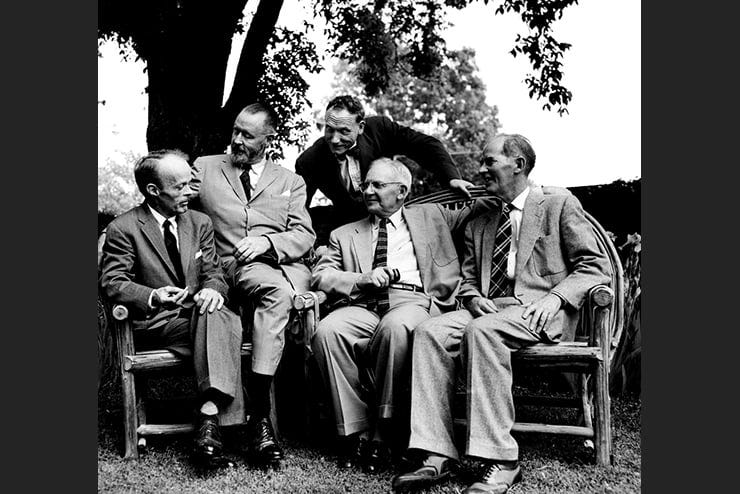
There’s so much more to say. The tradition is carried through the great Southern literature of the 20th century. Political thinkers like M. E. Bradford took up Jefferson and Calhoun and the Agrarians’ task. Wendell Berry peeks his head around the corner in not only critiquing industrialism, but further scrutinizing how industrialism seeped into agriculture itself and spoiled the land. Then Donald Livingston, Clyde Wilson, and James Kibler carried the torch into the 21st century.
But I’ll stop with John Crow Ransom because it brings me back to the Lindale Mill, and thus the conclusion.
I did not simply write this for the history of it—though that is of course fascinating in and of itself. I write because of President Trump’s vision to re-industrialize America. As a matter of fact, last fall J. D. Vance came to speak in the Lindale Mill at the tail end of the campaign trail. He praised the mill, bemoaned its closing, and promised that another Trump administration would be committed to bringing factories like Lindale Mill back.
I do not doubt President Trump or Vice President Vance’s good-willed intentions to bring jobs to the American people. It seems to me beyond clear that they truly mourn what happened to communities at the off-shoring of American industry.
I will say, though, that I pause at the thought of re-industrializing the South, and I hold that we would do well to adopt again the old hesitation I have tried to articulate.
Recall Ransom’s advice to seize upon what happened to New England industrial communities as exemplifications of detestable living. Well, I submit what happened to Lindale—what Ransom would call “the human catastrophe which occurs when a Southern village or rural community becomes the cheap labor of a miserable factory system.”
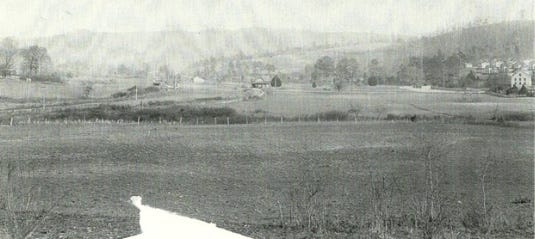
Consider this image. This was the Lindale farming village before the cotton mill. The old Grist Mill is on the far right. Mashed upon the pastures just beyond the first fence line today is the abandoned Lindale Mill (picture at the top of this page). That is what the Lindale Mill took away from the people farming in the Blue Ridge Hills.
Why did Thomas Jefferson say that cultivators of the earth are tied to their country & wedded to its liberty & interests by the most lasting bonds? Why did John Randolph of Roanoke and the Old Republicans believe that only in the country, on his own land and free from debt, did a man experience real liberty?
Well, not only because of the culture of agrarian living—the things that Ransom praised in the old South: Spiritual liberty, leisure, communion with nature and God, and the vita contemplativa that Aristotle held to be the best way to obtain happiness, as opposed to the vita activa of industry—but also because of the subsistence. Not a single man, nor even a board of directors, had the power to offshore a factory and send a lovely Southern town into oblivion.
That is why John Randolph of Roanoke told the Virginia legislature “the moment… you quit the land… that moment you will find yourselves at sea: and without compass—without land-mark or polar star.”
It’s why William Gilmore Simms said “the nation whose sons shrink from the culture of its fields will wither for long ages under the imperial sway of iron.” Manufacturing “may put on a face of brass,” Simms admitted, “but its legs will be made of clay.”
And yet we want to bring it back, after the clay legs cracked and the whole edifice fell?
It may be because Trump, Vance, and their economists believe this was simply the result of poor choices on behalf of America’s ruling class, of its economic and political leadership. To some degree that is correct, but I would push further: The very reason the factories and mills existed in the first place is the same reason they were offshored—man’s perceived mastery over nature lending itself to his pursuits of efficiency, cost reduction, increased profit, and mass production. Before the workers of mills across these United States had their jobs replaced and offshored, the mills replaced the tailors and cobblers, the craftsmen and the whole domestic system. Do we really think we can grab the Faustian spirit by the tail, dig our heels into the ground, and contain it?
Our Lord said to judge trees by the fruit they bear. When I pass the Lindale Mill, I see rotten fruit and trees engulfed in kudzu.
I do not have a precise plan moving forward. Perhaps re-industrialization will work and I am wrong. I have no finely detailed policy agenda. I have simply adopted that old hesitation, and all I know is that the cattle did not haul ass to China to turn a better profit, and the cotton never offshored its roots for cost efficiency’s sake.
But if I am not the one to sound the ways of the world
because my heart’s lack of feeling stands in the way,
then let me be satisfied with rural beauty,
streams bustling through the glens;
let me love woods and running water—
though I’ll have failed. Oh, for the open countryside
along the Spercheus, or the mountains of Taygetus,
its horde of Spartan maidens ripe for the picking!
Oh, for the one who’d lay me down to rest in
cool valleys of the Haemus range and mind
me in the shade of mighty branches!

…

Indeed he’s blessed, who’s comfortable with country gods—
Pan and old Sylvanus, and the sorority of nymphs.
High public office doesn’t turn his head,
nor regal pomp, nor civil strife when friends and allies are at odds,
nor the Dacian league descending from the Danube, nor even
all concerns and cares of Rome, or any one provisional domain.

For those with wants he feels a sorrow,
not envy for the ones with none.
The fruit on trees, all the country offers for the taking, he’ll gather.
To cruel codes of law, or madding market places,
or the public record office—he simply gives no thought.

…

A countryman cleaves earth with his crooked plough.
Such is the labour of his life.
So he sustains his native land and those
who follow in his footsteps; so he supports a team of oxen
and keeps cattle in good order.
All go and no let up—so that the seasons teem with fruit.
fields fill up with bullocks, and big arms of barley stand in stooks.
They’ve overflowed the furrows, they’ll burst the barns.

- Virgil, Georgics